

When a silicone or rubber component is removed from the mould, its manufacture is not always complete.
For certain applications, particularly in the medical, food, aerospace, automotive and chemical industries, an additional step known as post-curing is required to achieve the expected final performance.
What is post-curing?
Heat-curable elastomers, such as silicones and many technical rubbers, acquire their properties through a chemical cross-linking reaction brought about by the combined effect of temperature, pressure and a catalytic system.
Once moulding is complete, this cross-linking is largely complete, but certain volatile compounds from the vulcanisation system may still remain in the material.
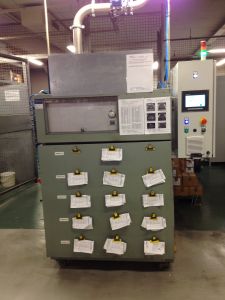
Post-curing therefore involves subjecting the moulded parts to an additional heat treatment, usually in a ventilated oven for a precisely defined duration and at a precisely defined temperature.
This process enables:
- the removal of some of the residual volatile compounds;
- to stabilise and standardise the part’s physical properties;
- to improve long-term performance.
Why carry out post-curing?
1. To reduce volatile residues
In food, medical or pharmaceutical applications, the presence of extractable or volatile compounds must be minimised.
Post-curing helps to further purify the material by promoting the migration outwards of certain residues resulting from the vulcanisation process.
This step is frequently required by regulatory specifications or the technical data sheets for the materials used.
2.Improving chemical resistance
The additional heat treatment promotes the densification of the elastomer network.
This more compact structure generally improves resistance to a wide range of chemical attacks:
- oils,
- fuels,
- solvents,
- acids,
- industrial cleaning products.
This characteristic is particularly sought after in harsh environments.
3. Optimising compression set (CS)
For a seal, maintaining its ability to exert contact pressure over time is essential.
Post-curing allows the material to continue cross-linking, reduces the number of residual reactive sites and eliminates certain by-products. The polymer network then becomes more stable and exhibits better creep resistance.
The result is often an improvement in Compression Set (CS), a key property for seals subjected to prolonged compression.
Does this apply to all materials?
The elastomers most commonly post-vulcanised are:
- silicones (VMQ),
- fluorosilicones (FVMQ),
- fluoroelastomers (FKM),
- polyacrylates (ACM).
For certain solid components, particularly those made of fluoroelastomer, the temperature must be raised gradually to prevent the build-up of internal stresses that could lead to cracking.
A process to be tailored to each project
The duration and temperature of post-curing are never chosen at random.
They depend in particular on:
- the elastomer formulation,
- the part’s geometry,
- its thickness,
- the required performance characteristics,
- the customer’s regulatory requirements.
Conversely, certain specific formulations, particularly self-lubricating elastomers, are generally not compatible with this process, as heat treatment inevitably leads to the evaporation or extraction of the lubricating agents present in surface of the material.
Our expertise
At Chevalier Cleret Eltec, we define and control post-curing cycles tailored to the requirements of each application in order to guarantee the expected performance in terms of sealing, chemical resistance and durability.
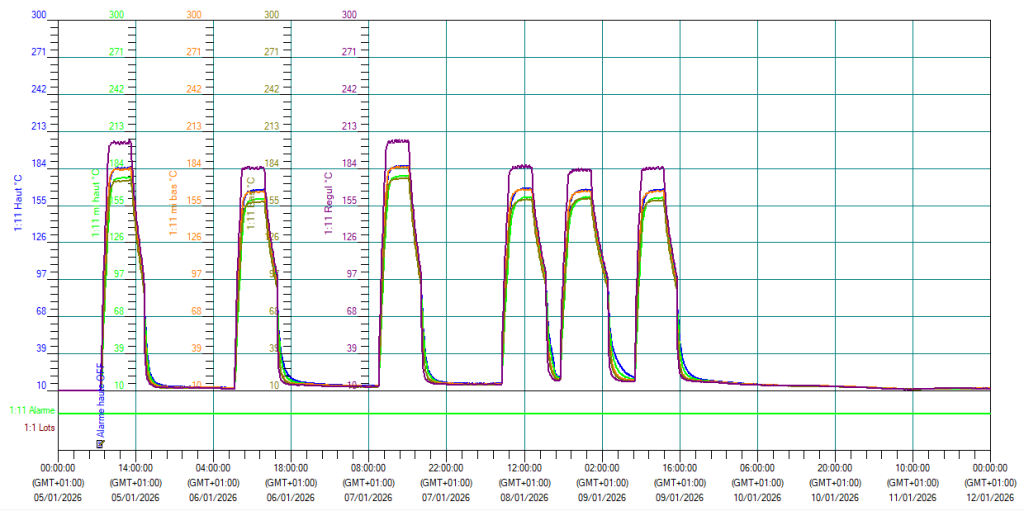
Our ovens are fitted with multiple temperature sensors positioned at various points to ensure uniform heat treatment. Temperatures are continuously monitored and recorded throughout the cycle.
Should temperatures deviate from the specified limits, a visual and audible alarm is triggered automatically. The cycle continues until completion, whilst access to the oven remains locked.
Parts that have undergone a non-compliant cycle may only be released by the Quality Department, which is the sole body authorised to approve their use. The products concerned are immediately identified and isolated, and are then subjected to an analysis to determine the appropriate course of action: scrapping, re-heat treatment, a possible exemption or any other suitable measure.
Do you have a project requiring technical components made of silicone or rubber that meet high performance or compliance standards?
Our teams are on hand to assist you in selecting the material and manufacturing process best suited to your needs.